Username:
Password:

Our history

cotton comes to liverpool

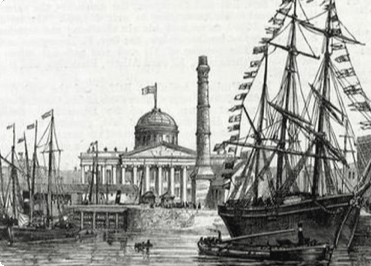
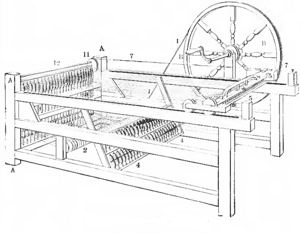
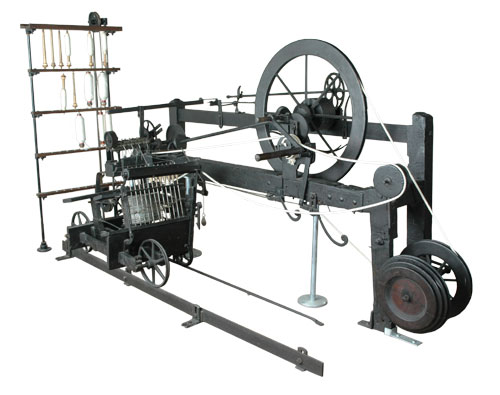
Raw cotton was being imported into Britain during the 17th Century. It entered the country primarily through the Port of London but, in 1709, the pattern of imports began to change when Liverpool received a small quantity of the 2,000 bales imported in that year into the country. Over the next 50 years further small quantities continued to pass through the city. In 1757 there was the first-ever recorded cotton auction in Liverpool. Thereafter, the Port’s proportion of cotton imports progressively increased, largely as a result of the inventions of Arkwright, Hargreaves and Samuel Crompton, which revolutionised the Lancashire spinning industry. By 1795, Liverpool was receiving the lion’s share of the 17,000 bales imported into Britain and, whereas the first imports consisted of West Indies and American cotton, from 1810 other growths became available on the Liverpool Cotton Market.

the open air market

Business was at first conducted informally on the quayside, in the streets or in the coffee houses. In 1808 the “New Exchange Building” was opened and cotton traders took offices in the new Building but persisted in their preference for doing business in the open air on what became known as “Exchange Flags”. This open space continued to act as the Cotton Market for almost 100 years. The hardship of open-air trading “on the flags” was adequately rewarded, however, by the ready access it gave to fellow traders to exchange their news.
 
The news available “on the flags” was not the only gossip and rumour. For example, from 1832 reliable information concerning the Market was provided in a weekly and monthly “General Circular”. These were publications produced as a communal effort by cotton traders. The advantages of this kind of co-operation were obvious and in 1841 it was decided to form “The Liverpool Cotton Brokers’ Association” in order to deal with matters of common interest. By 1863, it was possible for members to formulate and enforce rules for trading which embodied the best of current practices. In 1882 brokers found themselves in dispute with merchants over their respective functions and ultimately it was decided to form a new association that included both merchants and brokers. This organisation was named “The Liverpool Cotton Association” and the Association has continued along similar lines to the present day acting as the governing body of the Liverpool Cotton Exchange and as an Arbitration Authority and forum for traders throughout the world.
 
To reflect the membership base and the nature of the Association's business activities, on 9 December 2004, the Association was renamed “The International Cotton Association”.

improved methods of communication

The need to regulate trading in the Market became increasingly more important as the 19th Century wore on. The pace of business became more and more hectic as improved means of communication made it possible for information to arrive in advance of cargo vessels. 1840 saw the start of the Cunard Trans-Atlantic mail service by “steam packet” and in 1866 the first sub-marine cable service with North America came into operation. Finally, at the end of the century, the telephone was added to the apparatus of commerce.

the market moves indoors

Each of these events had a profound effect upon the Market. Samuel Cunard’s mail service carried reliable information on shipments and enabled traders to buy and sell cotton in the “Arrivals” Market. Dealings in Arrivals were speculative and could not have functioned on a falling market. The sub-marine cable provided the answer to this problem by enabling merchants to hedge their sales commitments by immediate purchases for shipment. The telephone speeded up the whole process of buying, hedging and selling. Ready access to a telephone became a business necessity. For this reason, the Market moved indoors and the present “Cotton Exchange Building” was opened in 1906 providing business accommodation with electric lifts, numerous telephones, synchronised electric clocks and a direct cable to the New York Cotton Futures Market. Trade flourished in its new home and, by means of a levy on contracts, the Building was paid for within 17 years.

the domestic market

Cotton arrivals in the United Kingdom reached their highest level in the 1911-1912 Season, when no less than 5,230,000 bales were imported, mostly to Liverpool. Liverpool was then the largest cotton importing market in the world providing an unequalled service to spinners in guaranteeing the availability of cotton for forward delivery positions and holding large warehouse stocks in Liverpool of all growths for ‘Spot’ sales.
 
However, by the end of the Season, the market had passed its peak of expansion. The export of cotton machinery and Lancashire “know-how” helped the development of cotton textile industries overseas and United Kingdom imports of raw cotton consequently declined. In spite of this development, however, the Liverpool Market remained active until the Second World War when, in 1941, due to wartime exigency, the control of purchasing and distribution of raw cotton passed into Government hands where it remained until a few years after the war, signalling a gradual return to free marketing of cotton.
 
The Earl of Derby officially reopened the Liverpool Cotton Exchange in 1954. Trading again increased quite considerably and in 1962 it was decided to reshape the International Cotton Association to meet the contemporary needs of the Market and of its members. The constitution of the Association was amended and in February 1963 it became incorporated as a company limited by guarantee. Full Membership was made available to individuals and to limited companies actively engaged in raw cotton trading in the United Kingdom. Associate Membership was made available to those engaged in cotton manufacturing and in allied industries in the United Kingdom and also to overseas organisations.

past presidents

Click here to view the full list of ICA Past Presidents

historical prints

The ICA holds a selection of old paintings, prints and photographs of Liverpool and the Cotton Exchange – please click here to see a selection of the prints that can be purchased.